Repair & Insurance
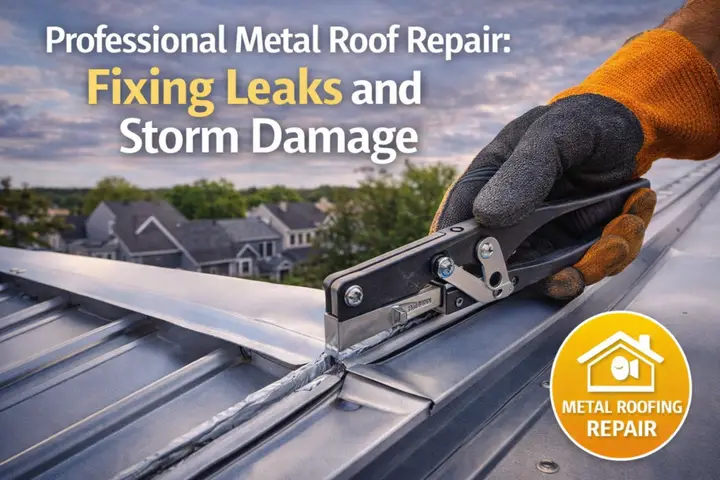
Metal roofs are legendary for their strength. They’re designed to withstand 140-mph winds and the scorching Florida sun. But even the toughest roof can develop problems, whether from decades of expansion and contraction or one violent afternoon of weather. Knowing the signs that you need metal roof repair can save you thousands of dollars in interior water damage.
Metal roofs rarely fail catastrophically. Small issues develop quietly instead. Here are the most common repair triggers we see across Florida, what storm damage actually looks like on metal, and how the insurance side works when a hurricane is involved.
Unlike asphalt shingles, which blow off or crack visibly, metal roofing issues are often subtle. If you notice any of the following, schedule a professional roof inspection.
The most obvious sign of trouble is water where it shouldn’t be. Brown spots on your ceiling or damp attic insulation mean the watertight barrier has been breached. On a metal roof, leaks rarely happen in the middle of a panel; they almost always occur at penetrations (vents, chimneys, skylights) or where panels meet at valleys and seams.
On an exposed fastener system, those screws work hard. Years of Florida thermal cycling (panels expanding in afternoon heat, contracting overnight) can back screws out slightly. If the rubber washer around a screw cracks or degrades, water seeps straight down the screw hole. Replacing fasteners is one of the most common and most affordable metal roof repairs, and catching it early is exactly what our maintenance guide is for.
Flashing seals the roof’s edges and the areas around chimneys and dormers. Bent, corroded, or detached flashing gives water a direct path into your home. Because flashing is custom-bent for your specific roof, repairing it well requires a specialized touch.
High wind and hail are the main enemies of any roof, and Florida delivers both. Metal doesn’t break like tile or tear like shingles, but it can still take damage.
Hail dents: large hail leaves visible pockmarks. Usually cosmetic, but severe impacts can break the paint finish and expose metal to corrosion.
Wind uplift: if an earlier installation wasn’t perfectly secured, extreme gusts can catch a panel edge, bending it back or loosening clips. This is the failure mode that turns into a real leak fast.
After any named storm passes through, do a ground-level check and photograph anything that looks wrong. Those photos matter for the next section. If the damage looks serious, our storm & hurricane roof damage service covers emergency tarping and the documentation that goes with it.
If a hurricane or hail event damaged your roof, the repair often runs through your homeowners policy, and how you document it affects the outcome. What works in practice:
We’re a licensed metal roofing contractor (FL License CCC1337805), and storm documentation support is part of every repair job we take.
It might be tempting to grab a tube of caulk and a ladder. Two reasons to resist. First, safety and walkability: metal panels are slippery, and stepping in the wrong spot kinks them, turning a repair into a replacement. Second, materials: hardware-store silicone doesn’t bond well to the Kynar and SMP finishes on modern panels. We use industrial-grade sealants and fasteners matched to the roof system, and we find the true entry point rather than the drip point. Water can enter at the ridge and travel twenty feet down a rafter before it ever shows on your ceiling.
The best time to fix a metal roof is before it leaks into your living room. We repair metal roofs across Central and Eastern Florida, from Orlando and Daytona Beach through Melbourne, Palm Bay, Vero Beach, and Port St. Lucie. Suspect a problem? Contact us for an evaluation, or request a free quote if the damage looks like replacement territory.
Repair & Insurance
Repair & Insurance
Repair & Insurance
Call us at (800) 303-3309 or request your free, no-obligation estimate below.
Call us at (800) 303-3309 or request your free, no-obligation estimate. We'll carefully evaluate your roof and answer your questions.
Get a Free Roof Quote Call (800) 303-3309