Repair & Insurance
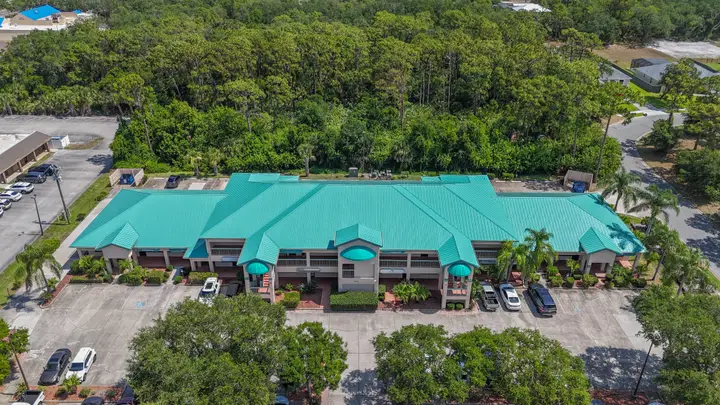
Florida’s roof-age insurance rules get written up constantly for single-family homeowners: the 15-year mark, the inspection option, what an insurer can and can’t do. Less gets written about what happens when the roof in question isn’t one person’s to replace. If you own a unit in a condo building or a townhome under an HOA, the short version is that the same underlying law applies, but who orders the inspection, who pays for it, and whose insurance policy is actually on the line all shift depending on how your property is structured. For the full explanation of the law itself, our roof-age insurance law article covers the single-family version in detail. This piece covers what’s different for shared ownership.
In a typical condominium, the roof is usually a common element, insured and maintained under the association’s master policy rather than any individual unit owner’s policy. A townhome is less consistent. Depending on how the HOA’s declaration is written, the roof over your unit might be a common element the association maintains, or it might be treated as part of your individually owned structure the same way a single-family roof would be. There isn’t one answer that covers every Florida townhome community.
This is not something to guess at. Your association’s governing documents, specifically the declaration of condominium or the HOA’s covenants, spell out exactly who is responsible for the roof. If you don’t have a copy or aren’t sure where roof responsibility falls, that document is the first thing to pull, not a general rule of thumb.
For a common-area roof, the board or association typically holds the authority to order an inspection, not an individual unit owner acting alone. That matters under the 2026 rule change, because the inspection that can protect a roof from an age-based non-renewal has to be ordered and paid for by whoever actually controls the asset. A unit owner worried about an aging roof over a shared building usually needs to raise it with the board, not schedule an inspection independently.
This stays informational rather than a claims process. If your board hasn’t addressed an aging common-area roof, the next step is asking about it at a board meeting or in writing, not filing anything with an insurer yourself.
A condo association’s master policy typically covers the building structure, the roof included, and roof age affects that policy’s renewal terms the same way it would affect a single-family policy, just at the association level instead of the individual level. Your own HO-6 policy, if you’re a unit owner, generally covers the interior of your unit and your belongings, not the roof over the whole building.
For a townhome where the roof is deeded to you individually, your own policy is the one roof age affects directly, closer to how a single-family home works. Either way, a licensed insurance agent who knows your specific policy and association structure is the right person to ask about how roof age is affecting your premium or renewal terms. This article explains the general framework, not your specific coverage.
Get a Licensed Damage Assessment
A written inspection from a licensed and insured Florida contractor (FL License CCC1337805) gives your board or agent documentation to work from. Informational only, never a claims service.
Request an AssessmentA condo or HOA board evaluating an aging common-area roof has a different set of questions than a single homeowner does. Ask for written inspection documentation the board can keep on file and share with the insurer if needed. Ask whether the contractor can provide a remaining-useful-life certification, the document insurers look for under the 2026 rule to avoid an age-based non-renewal. And verify licensing and insurance directly. We’re licensed and insured in Florida (FL License CCC1337805), and any contractor working on a shared building should be able to produce that documentation without hesitation.
None of this is legal advice, and a board facing a specific insurance dispute should talk to the association’s attorney or agent. This is what to ask a roofing contractor, not what your association is required to do.
We’re seeing more associations choose standing-seam or exposed-fastener metal for reroof projects, specifically because a 40 to 70 year service life changes the roof-age math for a shared building in a way asphalt shingle can’t. A board replacing a common-area roof once every 40 years instead of every 15 to 20 spends less on special assessments over time, even with a higher upfront cost. Our metal roof value guide walks through that payback math in more detail; it’s written for a single-family reader but the underlying numbers apply the same way to a shared roof.
Volusia County, Daytona Beach included, has real condo and HOA density along the coast, and coastal association boards are exactly the audience dealing with this most often. We work with boards and property managers throughout the area on inspections and reroof projects. Our Daytona Beach metal roofing page has local permitting details and the neighborhoods we cover. If a board member or property manager is trying to sort out who’s responsible for payment before calling anyone, our construction lien law article is worth reading first; it covers a related risk that shows up on shared-property roofing projects specifically.
Request a licensed damage assessment or read the full roof-age law explainer for the single-family version.
Yes, the underlying law applies regardless of ownership structure. What changes is who has the authority to order the inspection. For a common-area condo roof, that's typically the association's board, not an individual unit owner.
It depends on your association's governing documents. In most condos, roof replacement on a common element is funded through the association, often via reserves or a special assessment. Check your declaration of condominium for the specific answer that applies to your building.
An insurer can decline to renew a policy covering an aging roof under certain conditions, the same general framework that applies to single-family homes. A remaining-useful-life certification from a licensed inspector can protect against a non-renewal based on age alone. Ask your association's agent how this applies to your specific master policy.
It can, though the exact effect depends on the insurer and policy. A longer-lasting roof reduces the age-related risk an insurer is pricing in, and wind-rated metal systems can support wind-mitigation credits the same way they do for single-family homes. Ask your agent how a specific system affects your association's specific policy.
Ask for written inspection documentation, a remaining-useful-life certification if the roof is approaching the age threshold, and proof of Florida licensing and insurance. A contractor working on a shared building should be able to produce all three without hesitation.
Call us at (800) 303-3309 or request your free, no-obligation estimate below.
Call us at (800) 303-3309 or request your free, no-obligation estimate. We'll carefully evaluate your roof and answer your questions.
Get a Free Roof Quote Call (800) 303-3309